You may have heard lots of news around choking or strangulation during sex recently. It can be really overwhelming, especially if choking or strangulation during sex is something you engage in consensually or have been thinking about trying. This article is here to help you understand the risks, reduce the harm, and give some context as to why some people enjoy it during sex.
First off, what is choking? And what is strangulation?
Choking is when something inside your airway (like a piece of food for example) impacts your ability to breathe. Strangulation is when there is pressure on your neck that impacts your breathing and/or blood flow from the outside. Strangulation includes with hands, arms, or objects such as clothing, belts, or ropes. So, we often hear the word ‘choking’ used when the act is actually ‘strangulation’.
Sexual Strangulation is the act of intentionally restricting airflow to enhance sexual arousal. It’s something that you can do to yourself or have done to you or that you may do to others. However, it carries significant physical risks and needs to be seriously thought about with regard to consent and safety. The first thing to mention is that if you’ve done this or have experienced this, you’re not alone. In a recent survey of 4,700 young Australians, 57% had been strangled during sex. But, where does this trend come from? And what is the appeal?
Lots of people are choosing to participate in sexual strangulation as they have seen it in pornography, heard about it from movies, or even heard about it through friends or other partners. A lot of the appeal for sexual strangulation comes from the idea of a dominant and submissive power dynamic or about wanting to be adventurous or kinky – some people are even excited by the risk.
There is no shame in wanting to try new things, but it’s important to have all the facts. Although engaging in sexual strangulation can be a way for you to explore power dynamics or breath play, there are some serious health concerns and risks related to sexual strangulation that you might not even know!
So…what are the risks?
Being strangled cuts off the oxygen supply to your lungs. This in turn means your brain and body cannot function normally. If you are deprived of oxygen for long enough you can lose consciousness. If the lack of oxygen goes for too long, it can cause brain injury and death. Other damage can still occur even if you don’t pass out! This can include dizziness, headaches, memory loss, confusion, and loss of bladder or bowel control, amnesia, stroke, psychosis, long term traumatic brain damage.
There is no safe way to engage in strangulation. This is because strangulation effects are unpredictable and can have immediate, short-term, and long-term effects which range from mild to severe and life-threatening. For example, swelling around your throat that may not appear until later – when you are not with someone and aren’t able to get help.
The neck is a massively fragile part of the body containing structures that are critical for you to stay alive. Strangulation can cut off oxygen supply to your brain with only a very small amount of pressure. Your brain needs oxygen to survive, cutting of this oxygen and restricting blood flow can have devastating irreversible effects. The arteries that supply blood to your brain are in the neck and if they get damaged, they can cause clots to your brain which may end in a stroke.
Another big and complex issue with sexual strangulation is consent.
Consent means freely choosing to take part in something, and it should always be informed. That means understanding what you’re agreeing to, including the possible risks, and knowing that you can change your mind at any time.
The problem with sexual strangulation is that the risks can be serious, unpredictable and sometimes fatal. Someone can be seriously injured even when both people agreed to it, and there can be legal consequences is someone is seriously hurt or dies.
You can’t make sexual strangulation safe just by agreeing to it. There is always a risk of serious harm, and sometimes that harm can happen without obvious warning signs.
Sexual strangulation can also be used as a form of domestic and sexual violence. If someone strangles or chokes you without your consent, pressures you to do it, or uses it to control, frighten or hurt you, this is abuse – and it’s not your fault. Find support information at the end of this article.
There are no ways to engage in strangulation or breath play that are 100% guaranteed to be safe.
So we recommend that you try alternate activities that don’t run such high risks.
However, if you are going to do so, here are some tips to minimise harm.
- Establish clear communication beforehand, decide on a specific word, or gesture that indicates to your partner that you want to stop.
- Make sure that everyone involved is educated on the risks and how to respond in case of an emergency.
- Limit the amount of time you spend engaging in these activities. It is perfectly fine to have sex and not involve strangulation at all.
- Avoid complete restriction of breath.
- Be aware of any warning signs that your partner is in distress or is having difficulty breathing beyond discussed.
Signs to look out for: Here are some red flag symptoms to look out for that require you seek immediate medical attention.
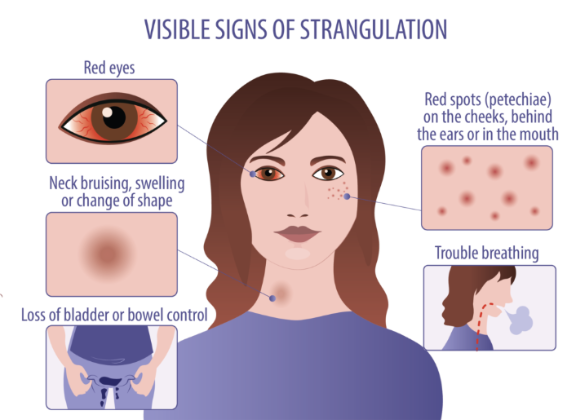
Image source: itleftnomarks.org.au
It’s important to remember that your throat can continue to swell for several days after an event. Whilst it’s common to have headaches and difficulty thinking straight, it isn’t common for these to continue or worsen. If this does happen or the symptoms persist for more than a week, seek medical attention. Having visible signs of strangulation can mean there are also internal injuries that should be checked out.
So, what are the alternatives?
This depends on why strangulation as a concept appeals to you. Is this something you’re taking part in because it turns you on and feels good? Or do you feel there is an expectation to be strangled because you’ve seen it in porn? Or because your peers have done it? Or your partner(s) think that you should? Take a moment to decide if this is an activity that makes sex feel better for you. Sex should be a fun experience that makes you feel safe and comfortable, does choking/strangulation make you feel this way? If not, you do not have to do it.
Porn is never a great representation of what real sex looks like. When you’re young and trying to discover what type of sex you like to have and how you like to have it, you can feel pressure to act a certain way. But using porn as a guide for your sexual experiences is like watching Fast and Furious to learn how to drive – it’s entertaining, it involves cars, and people are driving but it’s ultimately unhelpful in your end goal.
If there are aspects of strangulation that you do enjoy and would like to explore safer alternatives, here are some ideas. If it’s to do with the power dynamic there are lots of ways to explore this without having to restrict breathing. For example, using restrains or ties on safer less delicate parts of your body such as your wrists or ankles can emanate a feeling of power exchange.
If you enjoy the sensation of someone playing with your neck, explore other lighter means for contact. For example, using ice or feathers or tickling to create different sensations, or even applying light pressure and touch with your tongue or lips. The neck has tonnes of sensitive nerve endings so touch there can feel really good! Or if it’s because you enjoy the sensation of pain for pleasure you could explore things like impact play with spanking, this can create a sensation of pain without causing risk to life.
Remember it’s okay to feel curious about sex and trying new things but there is no recommended safe way to strangle, and any amount of pressure can be life changing for both people involved.
For more information and support visit:
For help with strangulation as domestic and family or sexual violence call:
- NSW Domestic Violence Line: 1800 65 64 63
- 1800RESPECT: 1800 737 732
If you are in immediate danger call ‘000’ and ask for the police or an ambulance.
Reference:
Sharman LS, Fitzgerald R, Douglas H. Prevalence of Sexual Strangulation/Choking Among Australian 18-35 Year-Olds. Arch Sex Behav. 2025 Feb;54(2):465-480. doi: 10.1007/s10508-024-02937-y